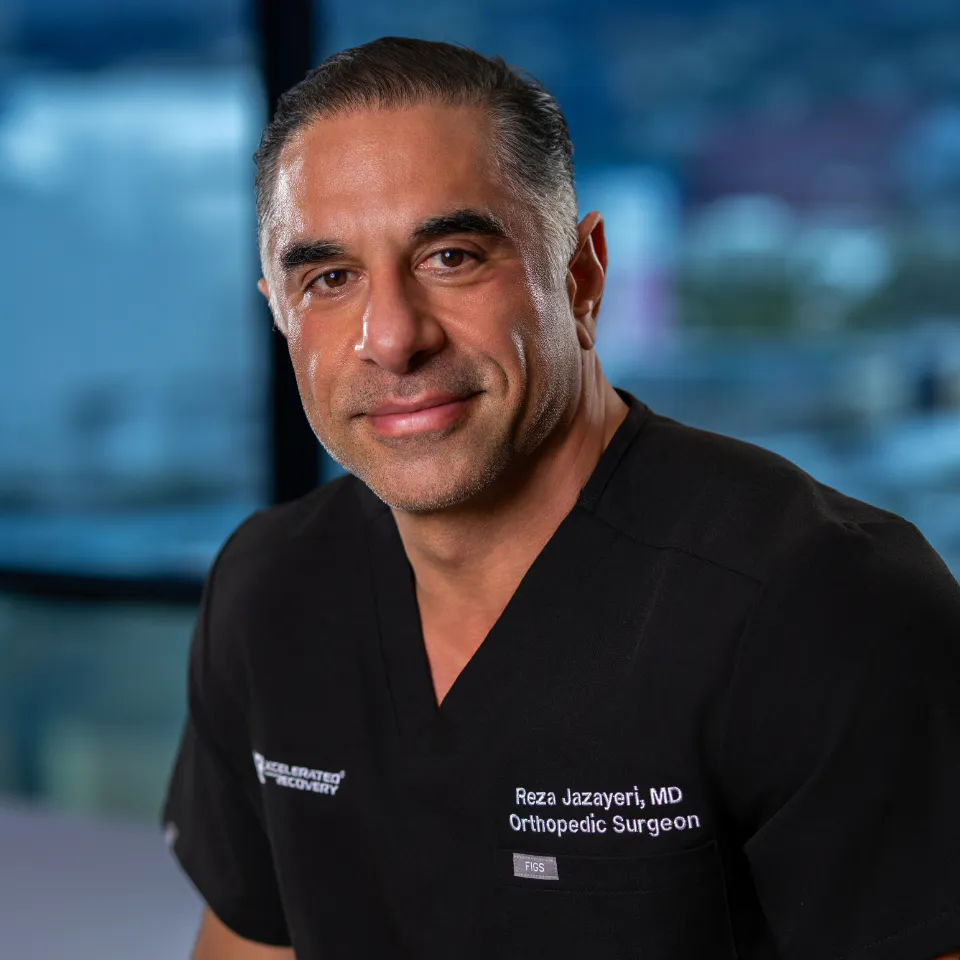
Meniscal root tears can change how your knee feels and functions. Dr. Reza Jazayeri, a double board-certified orthopedic surgeon specializing in sports medicine, completed his fellowship at the Kerlan-Jobe Orthopaedic Clinic in Los Angeles. He brings over 15 years of experience to diagnosing and treating these specific knee injuries.
His clinical focus on the shoulder, knee, and elbow means he sees meniscal root tears regularly in athletes, active adults, and older patients at his Beverly Hills, Westlake Village, and Orange offices. Getting the right treatment early matters because these tears affect the meniscus at its critical attachment point to bone.
What Is a Meniscal Root Tear?
Your knee has two menisci—cartilage pads that act like shock absorbers between the thighbone and shinbone. These menisci are anchored to the tibia (shinbone) by their roots. A meniscal root tear occurs when one of these anchoring points becomes damaged, either through trauma or degenerative wear.
Though often underdiagnosed, these tears are serious: they functionally disconnect the meniscus, rendering it unable to protect the joint. This is biomechanically equivalent to having the meniscus completely removed, which dramatically increases stress on the cartilage and accelerates joint degeneration.
Why Does It Matter?
Biomechanically, the meniscal roots help convert and disperse axial load across the knee joint as hoop stresses. This function is critical—about 50–70% of the load in both the medial and lateral compartments is absorbed by the meniscus. When a root tear occurs:
- These hoop stresses are lost.
- Contact pressures in the joint spike to supraphysiologic levels.
- The tibiofemoral contact area shrinks, increasing wear and tear on the cartilage—similar to what’s seen after a total meniscectomy (complete removal of the meniscus).

The Case for Surgical Repair
Strong Evidence, Better Outcomes
Surgical repair of meniscal root tears has consistently shown to provide significantly better long-term results than either partial meniscectomy (removal of part of the meniscus) or non-surgical management:
- In one study, 35% of patients who had partial meniscectomy required total knee replacement (TKA), while none of the patients who had root repair did.
- Another study found 52% of meniscectomy patients progressed to TKA within 4.5 years, versus far fewer in the repair group.
- In contrast, long-term outcomes after repair are excellent:
- 96% of patients reported good results.
- Only 1% required TKA at a 7.1-year follow-up.
- Just 14% showed any meaningful arthritis progression (≥2 grade worsening on the Kellgren-Lawrence scale) over 6 years.
These numbers make a powerful case: if the knee is otherwise healthy and the tear is repairable, surgery is not just helpful—it’s protective.
Not All Repairs Are Equal
However, it’s important to understand that surgical repair alone doesn’t guarantee healing. In some cases, the tissue doesn’t fully heal or the meniscus remains extruded (pushed outward), continuing to expose the joint to damage.
To optimize outcomes:
- The meniscus must be reduced (repositioned) anatomically during surgery.
- Meniscal extrusion should be corrected, as persistent extrusion is linked to early cartilage degeneration.
- Surgical technique and fixation strength are crucial to protect the repair during the early healing phase.
Patient Selection and Healing Optimization
Who Is the Ideal Candidate?
Success rates depend not just on the surgery, but also on selecting the right patients and preparing the joint for optimal healing.
Good candidates typically:
- Are active and under age 65
- Have limited arthritis (Kellgren-Lawrence grade 0–2)
- Have good alignment (less than 5° varus or valgus deformity)
- Have a BMI <30
Factors Leading to Poor Outcomes
Patients with the following traits face higher risk of complications or repair failure:
- BMI >35: Associated with a 25% reoperation rate, and 75% developed osteoarthritis vs. 29% in normal-weight peers
- Severe cartilage damage or subchondral bone collapse
- Advanced arthritis
- Untreated knee malalignment
Dr. Jazayeri’s Comprehensive Approach
Dr. Jazayeri is not only focused on the mechanical aspect of the surgery, but also on creating the best biological environment for healing. His patient-specific approach includes:
- Advanced Fixation Techniques: Using minimally invasive but biomechanically superior constructs (like the transtibial pull-out technique and cinch sutures) to ensure durable repair.
- Metabolic and Nutritional Optimization: Assessing each patient’s bone health, hormonal balance, and nutritional status—factors often overlooked but critical to healing.
- Biologic Augmentation: When appropriate, he incorporates Platelet-Rich Plasma (PRP) or Bone Marrow Aspirate Concentrate (BMAC) to enhance the healing response at the repair site.
Every case is carefully evaluated and discussed with the patient in a shared decision-making model, ensuring the plan aligns with both medical needs and personal goals.


What to Expect After Surgery
Postoperative healing requires commitment and protection:
- First 6 Weeks: Limited weight-bearing (toe-touch only), restricted knee motion (0–90° flexion).
- 6–12 Weeks: Gradual return to full weight-bearing and range of motion.
- 3–6 Months: Strengthening and gradual return to activities.
- Full return to sports or high-impact activities may take 4–6 months, depending on progress.
The Cost-Effectiveness Argument
A recent cost model–based meta-analysis showed the long-term economic value of root repair:
Knee osteoarthritis rates at 10 years:
- 53.0% for repair
- 99.3% for meniscectomy
- 95.1% for conservative treatment
TKA (total knee replacement) rates:
- 33.5% for repair
- 51.5% for meniscectomy
- 45.5% for conservative treatment
Conclusion: Meniscal root repair isn’t just clinically effective—it’s also economically smart, preserving quality of life and reducing the need for future surgeries.
KNEE ARTHROSCOPY POST OPERATIVE PATIENT
What to expect with your knee arthroscopy surgery.
Frequently Asked Questions
-
Meniscal root tears occur at the point where the meniscus cartilage attaches to the bone. These tears can lead to pain, swelling, and instability in the knee, making it hard to perform daily activities.
-
Treatment options include non-surgical methods like physical therapy and injections, as well as surgical procedures such as meniscal root repair. The choice depends on factors like the patient’s age, activity level, and the severity of the tear.
-
Recovery typically takes about four to six weeks of limited weight-bearing with crutches. Full recovery for sports or heavy activities usually takes five to six months, with physical therapy playing a key role throughout the process.
-
Physical therapy is essential for regaining strength and mobility after a meniscal root tear. It helps reduce swelling, restore range of motion, and prepares you for a safe return to your activities.
-
Preparation includes prehabilitation exercises to strengthen the knee and preoperative lab tests to check for any deficiencies. Following clear pre-op instructions will also help ensure a smoother surgical experience.
Why Choose Us For Meniscal Root Tear Treatment?
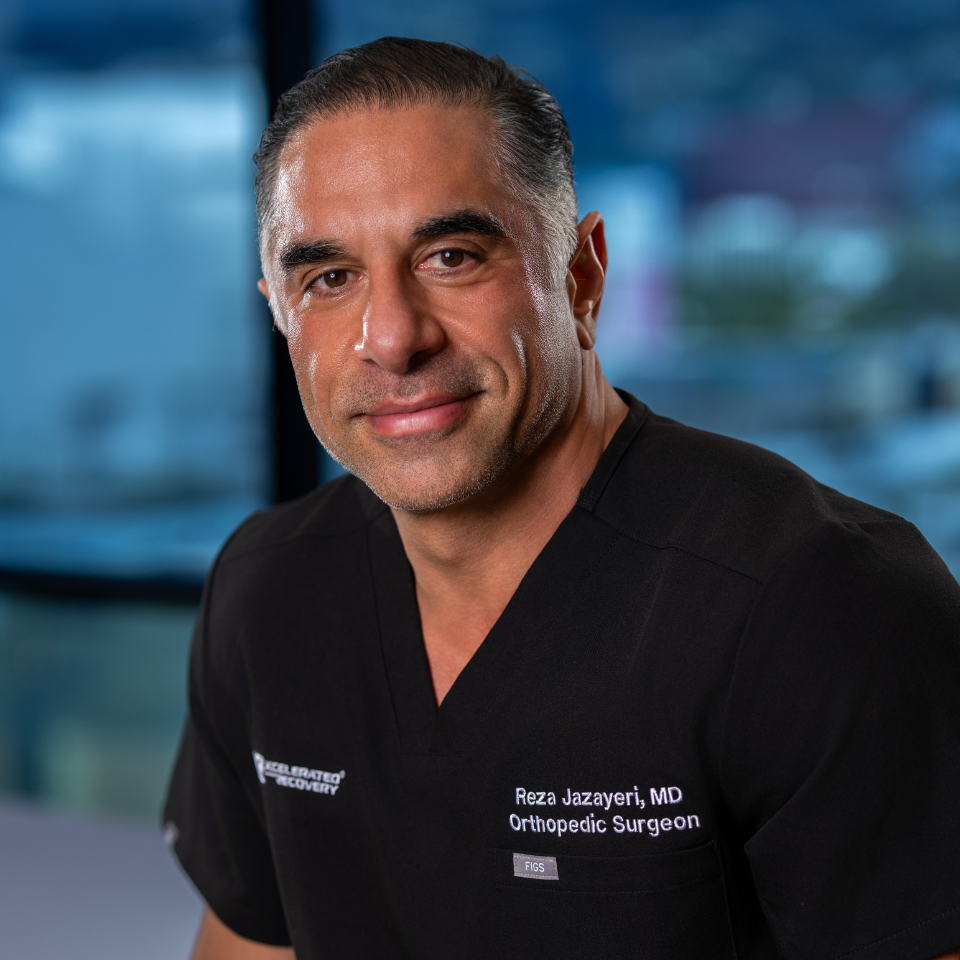
We understand how meniscal root tears can impact your daily life. Dr. Reza Jazayeri is a double board-certified orthopedic surgeon with over 15 years of experience treating knee injuries.
His specialized training at the Kerlan-Jobe Orthopaedic Clinic means you’re in capable hands. We focus on personalized care, ensuring you receive the best treatment options based on your needs.
Our approach combines advanced surgical techniques with a non-surgical-first philosophy. We prioritize your recovery by exploring physical therapy and injections before considering surgery.
If surgery is necessary, Dr. Jaz uses minimally invasive methods to support recovery. With a focus on nutrition and rehabilitation, we aim to get you back to your active lifestyle as soon as possible.
Meet Dr. Reza Jazayeri
Dr. Reza Jazayeri specializes in sports medicine with expertise in shoulder, knee, and elbow injuries. A Southern California native, Dr. Jazayeri combines an engineering background with elite surgical training, completing his orthopedic surgery residency at the nationally ranked NYU Hospital for Joint Diseases and a sports medicine fellowship at the renowned Kerlan-Jobe Orthopaedic Clinic.
After more than 15 years caring for patients within the Southern California Permanente Medical Group, Dr. Jazayeri joined DOCS Health to expand a practice focused on personalized orthopedic and sports medicine care and surgical excellence. As Director of Longevity at DOCS Health, he leads the development and implementation of optimization protocols and regenerative medicine strategies designed to improve long-term musculoskeletal health and extend healthspan.
His published work includes a 2026 coauthored review of nutritional optimization in spine surgery in the Journal of the American Academy of Orthopaedic Surgeons. View Dr. Jazayeri’s research publications and training.
i’m a physician in the LA area about 10 years out of school. I tore my right pec muscle in the gym and immediately called my ortho friends in the area for a recommendation (none of them did pec/shoulder). Dr Jax came highly recommended and I was not disappointed. his urgency and communication was excellent , got me scheduled right away and was checking on me the whole way. really felt like he went above and beyond during the surgery adding a bone marrow aspirate to help it heal. 9 months out and strength and mobility are great
Schedule Your Consultation For Meniscal Root Tear Treatment
In Summary, Meniscal root tears are often underrecognized but carry significant consequences if left untreated. When appropriate, surgical repair provides the best opportunity to restore knee biomechanics, protect joint cartilage, and prevent early osteoarthritis or the need for joint replacement. However, not all repairs are equal—successful outcomes depend on proper patient selection, surgical technique, and biological factors that support healing.
Dr. Jazayeri’s approach reflects the growing understanding that effective treatment requires more than mechanical fixation. By integrating advanced arthroscopic techniques with attention to metabolic health and considering biologic augmentation when indicated, each patient receives a tailored strategy aimed at optimizing healing and long-term function.
Patients experiencing persistent knee pain, particularly those with risk factors for meniscal root injury, are encouraged to seek a thorough evaluation at our Beverly Hills, Westlake Village, or Orange office and explore the most up-to-date, evidence-based options for joint preservation.
Medically reviewed by Reza Jazayeri, M.D. on