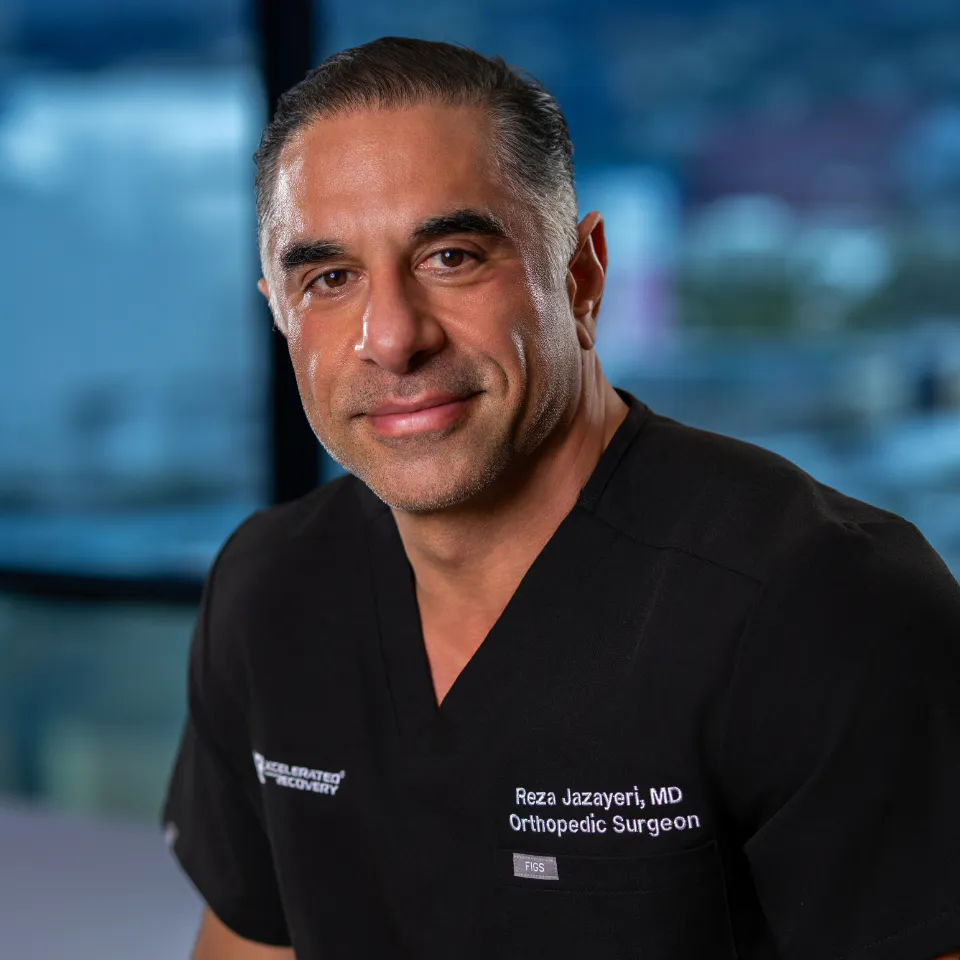
Recovering From Your
Shoulder Replacement
This guide explains what to expect as you recover from your shoulder replacement. Please read
it completely, and ask your nurse or Dr. Jazayeri to clarify anything before you leave the hospital.
Everyone heals at their own pace. Use this as a general roadmap and follow
any specific instructions your care team gives you.
Before your surgery
- Fill your prescriptions in advance so your pain medication is ready when you get home.
- No solid food after midnight the night before surgery. You may have clear fluids up to 2 hours before surgery: Gatorade (recommended), apple juice, black coffee with no milk, or tea.
- Arrange a ride, since you cannot drive after anesthesia and while taking pain medication.
- Most patients go home the same day, but a few stay one night for care, so it can help to have a small overnight bag ready just in case.
Questions & Care
Call, clinic hours
After hours
Use the after-hours nurse advice line listed on your discharge paperwork.
Emergencies
For a medical emergency, call 911.
Office
DOCS Health, 8436 W 3rd St, Ste 800, Los Angeles, CA 90048
!
Call the office if you notice
- A fever above 101.5 F
- Increasing redness around the incision
- Drainage from the incision site
- Any adverse effects from your medications
Call us to arrange an evaluation. For a medical emergency, call 911.
Recovery at a Glance
Day 3
First shower, dressing stays on
10 to 14 days
Suture removal
2 weeks
Dressing removed, physical therapy begins
2 to 3 weeks
Therapy ramps up
4 weeks
Driving usually safe
5 to 6 weeks
Shoulder swelling settles
1
Right After Surgery
In the recovery room and heading home
- Most patients go home the same day, usually after a couple of hours in the recovery room. A few patients stay one night in the hospital for post-operative care.
- You cannot drive yourself. Have someone available to drive you home.
2
Managing Pain
Staying ahead of discomfort
- You may receive a nerve block along with general anesthesia. It typically lasts 12 to 24 hours.
- Take your first oral pain medication when you get home, before the block wears off, and again before bed. It is normal to feel more pain overnight or the next day as the block fades.
- Always take your medications as directed.
3
Swelling and Icing
What is normal, and how to ease it
- Swelling and discomfort are normal in the shoulder for 5 to 6 weeks after surgery.
- Some skin discoloration is normal around the incision. You may also notice swelling in the chest, arm, and hand for 3 to 4 weeks.
- Ice to control swelling, 20 to 30 minutes at a time every hour or two. Put a thin towel or t-shirt against your skin if you use ice in a plastic bag.
Icing matters most in the first 48 to 72 hours, though many people find it keeps easing pain after that. - Sleep propped up. Lying flat can increase discomfort. Many patients rest more comfortably in a recliner, or propped up in bed, for the first 6 weeks. A pillow behind your elbow can help.
4
Wound Care and Showering
Keeping the incision clean and dry
- Your waterproof dressing stays on until your 2 week visit, when a physician assistant will remove it.
- You may shower on day 3. Avoid or minimize getting the dressing wet. You may take the sling off to shower, but keep a water resistant pillow under your arm to hold the elbow and shoulder away from your body, the way the sling does. Gently pat the area dry.
Do not soak the shoulder in water. - No swimming in a pool or ocean until your sutures are removed.
5
Your Medications
Filled before surgery. Always take as directed.
-
Percocet 10/325 mg Narcotic pain
Take 1 to 2 pills as needed every 6 hours, usually for the first 2 weeks. After that, if pain continues, a non-narcotic option (Tramadol) plus Tylenol and NSAIDs may be used. -
Mobic 15 mg NSAID, anti-inflammatory
Take 1 pill every 12 hours for the first 2 weeks. -
Colace 100 mg Stool softener
Take 1 tablet 2 to 3 times a day while taking pain medication, which often causes constipation. -
Zofran 4 mg Anti-nausea
Take 1 tablet every 6 hours as needed for nausea, which can follow anesthesia.
If you have any adverse effects from your medications, call the office during clinic hours. For a medical emergency, call 911.
6
Sling and Rehab
Protecting the new joint while you heal
- Wear your sling as directed by Dr. Jazayeri. Remove it 2 to 3 times a day to move your fingers, hand, wrist, and elbow. This helps reduce swelling.
- Use the MyHealthTrack app to guide your rehab starting the day after surgery.
- Physical therapy usually starts about 2 to 3 weeks after surgery, depending on the type of replacement and repair you had. The exact timing is confirmed at your first follow-up visit.
- Combine the app and in-person PT to get the most out of your recovery.
- Confirm your physical therapy appointment is scheduled by calling 1-844-JAZ-0911.
7
Follow Up
Your next visit and getting back
- Schedule your suture removal for 10 to 14 days after surgery.
- Plan a few days off work. Rest is a key part of recovery, so do not overdo it.
- Driving is usually safe about 4 weeks after surgery.
- Call the office if you develop a fever above 101.5, redness, or drainage from the incision, so we can arrange an evaluation.
Have a speedy recovery.
Dr. Reza Jazayeri, MD and Staff
Orthopaedic Surgery and Sports Medicine · DOCS Health
Orthopaedic Surgery and Sports Medicine · DOCS Health
Medically reviewed by Reza Jazayeri, M.D. on